Are Expensive Solar Panels Actually Worth It?
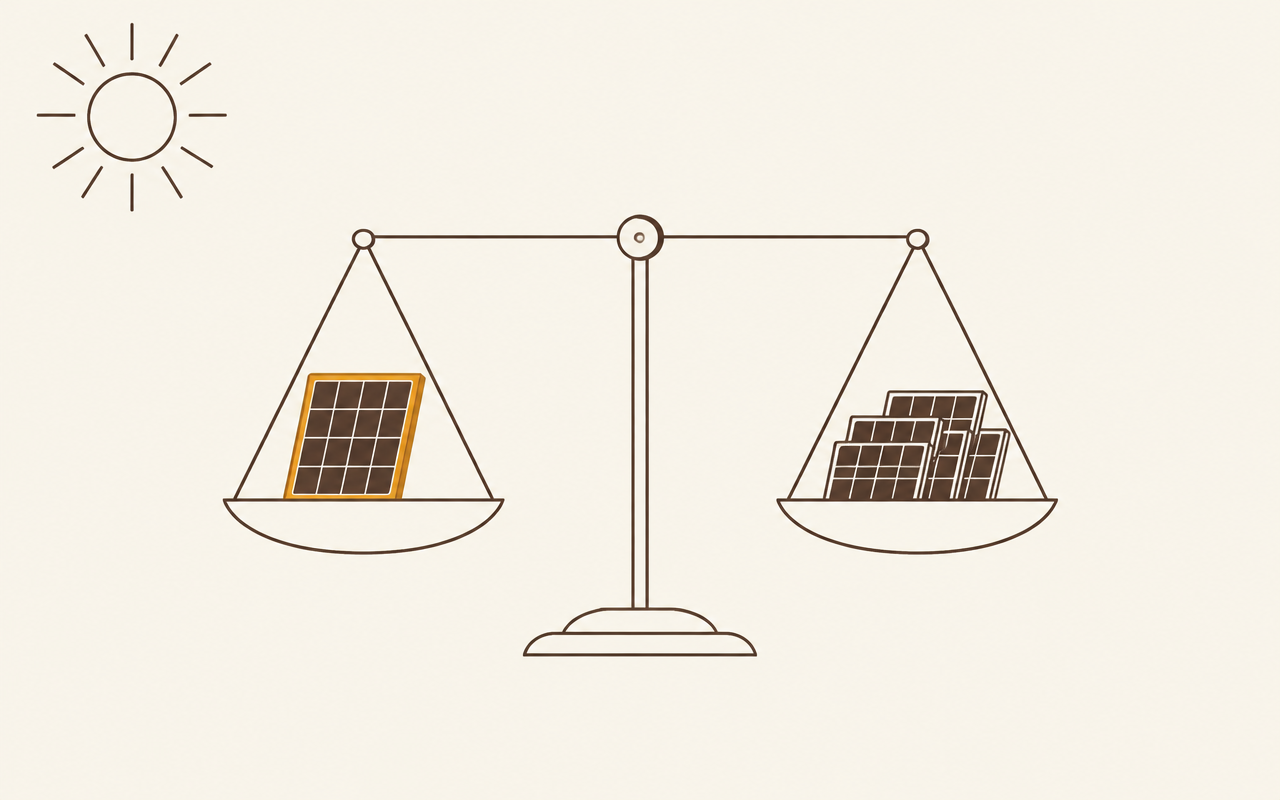
Solar panels can differ significantly in price, but a more expensive panel does not automatically produce cheaper electricity. The real question is whether its additional efficiency, heat resistance, durability, and lifetime energy production justify its higher upfront cost. The International Energy Agency reports that solar-panel prices fell by more than 60% between 2019 and 2024, largely because of manufacturing improvements, higher efficiency, and economies of scale. This has made solar panels increasingly standardized products, meaning buyers must look beyond price and brand reputation to compare actual performance.
From a physics perspective, a panel's efficiency determines how much sunlight it converts into electricity. A 22%-efficient panel converts more incoming solar energy per unit of surface area than an otherwise comparable 20%-efficient panel. This difference becomes especially valuable when roof space is limited. However, efficiency is not the same as total power output: a larger, less-efficient panel can still generate more electricity than a smaller, more-efficient one. The manufacturing process also matters. Conventional crystalline-silicon panels dominate the market, while newer technologies such as TOPCon and heterojunction (HJT) can achieve higher efficiencies and, depending on the model, lower temperature-related power losses.
Heat is another important physical factor, particularly in Indonesia. Solar cells produce electricity through the photovoltaic effect: photons transfer energy to electrons in a semiconductor, allowing an electrical current to flow. As the cells heat up, their voltage generally decreases, reducing their output power. Some premium technologies, such as HJT, have lower temperature coefficients, meaning they lose less power as temperature rises. Nevertheless, an expensive panel is not necessarily better at handling heat; the actual manufacturer's temperature coefficient must be checked. Long-term degradation also matters, since a panel that retains more of its original output can generate more electricity over its lifetime.
Economically, the correct comparison is not simply the purchase price of one panel, but the cost of the electricity generated over its lifetime. Higher-efficiency panels can reduce the number of panels, mounting structures, and installation work required to reach a target capacity, especially when roof space is limited. However, a National Renewable Energy Laboratory study found that the financial value of higher efficiency is much greater for space-constrained rooftops than for installations where space is plentiful. If two systems generate similar amounts of electricity and the cheaper option has comparable reliability and warranty coverage, paying extra for a premium brand may not be worthwhile.
In our view, the best solar panel is not necessarily the cheapest or the most expensive, but the one that delivers the lowest lifetime cost per unit of electricity. For Indonesian households, we would prioritize a reputable manufacturer, verified efficiency, a favorable temperature coefficient, low expected degradation, and a reliable warranty before paying extra for premium branding. A cheaper panel can be the smarter investment if it provides comparable lifetime output, while a premium panel earns its price when its additional energy production or space savings outweigh its higher cost. The decision should ultimately be based on measurable performance and total system economics, not price alone.
- National Renewable Energy Laboratory — The Effect of Photovoltaic Module Efficiency on Installed System Costs and Markets in Residential Rooftop Installations
- EnergySage — Which Type of Solar Panel Should You Choose?
- The Environmental Factors Affecting Solar Photovoltaic Output — Renewable and Sustainable Energy Reviews