BRIN's Study on Next-Generation Solar Panels
BRIN, Indonesia's national research agency, is studying whether Indonesia could manufacture newer, more efficient solar panels instead of only assembling panels from imported parts. The researcher, Oo Abdul Rosyid, explains that the global market is shifting from conventional silicon panels to two advanced technologies: silicon heterojunction (HJT) cells, with efficiency above 27%, and perovskite–silicon tandem cells, which could exceed 30% in the lab.
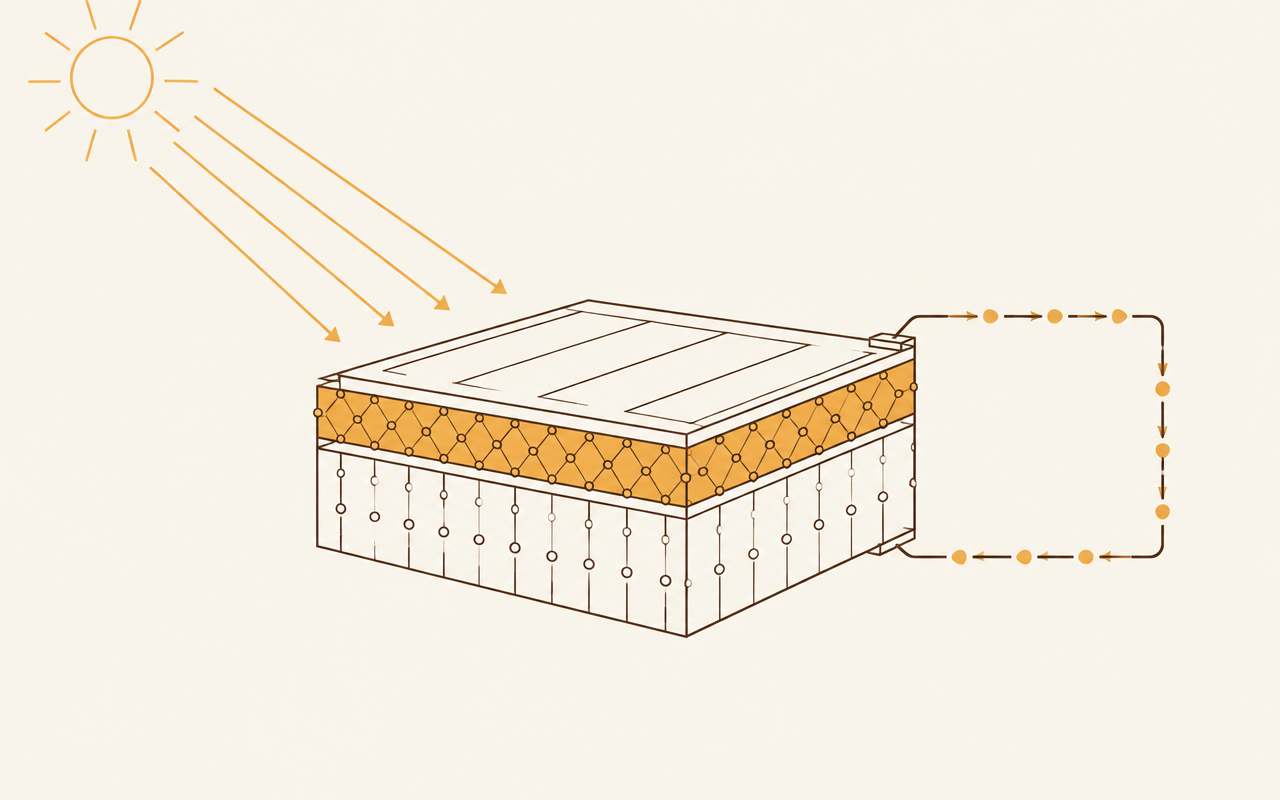
A solar cell works when photons from sunlight knock electrons loose, and an electric field inside the cell pushes them into a current. Every material has a "bandgap," the minimum energy a photon needs to free an electron. Photons with too little energy pass through unused, while photons with too much energy waste the extra as heat. This gives silicon-only cells a natural limit of about 29–30%. HJT cells get close to this limit by covering the silicon with ultra-thin layers that repair surface defects, so fewer electrons are lost before they can be collected. Tandem cells go beyond the limit by stacking perovskite on top of silicon: perovskite absorbs high-energy blue light, and silicon captures the red and infrared light that passes through.
These technologies also handle heat better. Panels lose power as they get hotter, because heat increases electron losses and lowers voltage. HJT panels lose only about 0.25% of their power per degree Celsius, compared with 0.35–0.40% for conventional panels — a meaningful advantage on hot Indonesian rooftops. BRIN suggests Indonesia skip older cell technology, start with HJT, and later move to tandem. Research done in Germany is expected to shape a national roadmap.
In our view, the plan is scientifically sound, especially for HJT, whose heat resistance is a real benefit in the tropics. However, the study overlooks key challenges. Perovskite degrades in heat, humidity, and UV light, which makes Indonesia's climate a difficult environment for tandem cells. Perovskite also usually contains lead, and HJT uses costly metals like silver and indium. Indonesia would also have to compete with China's low-cost production. Overall, HJT looks like a realistic near-term goal, while tandem remains a long-term bet that depends on solving perovskite's durability problems.