Seasonal Changes in Solar Irradiation in Indonesia
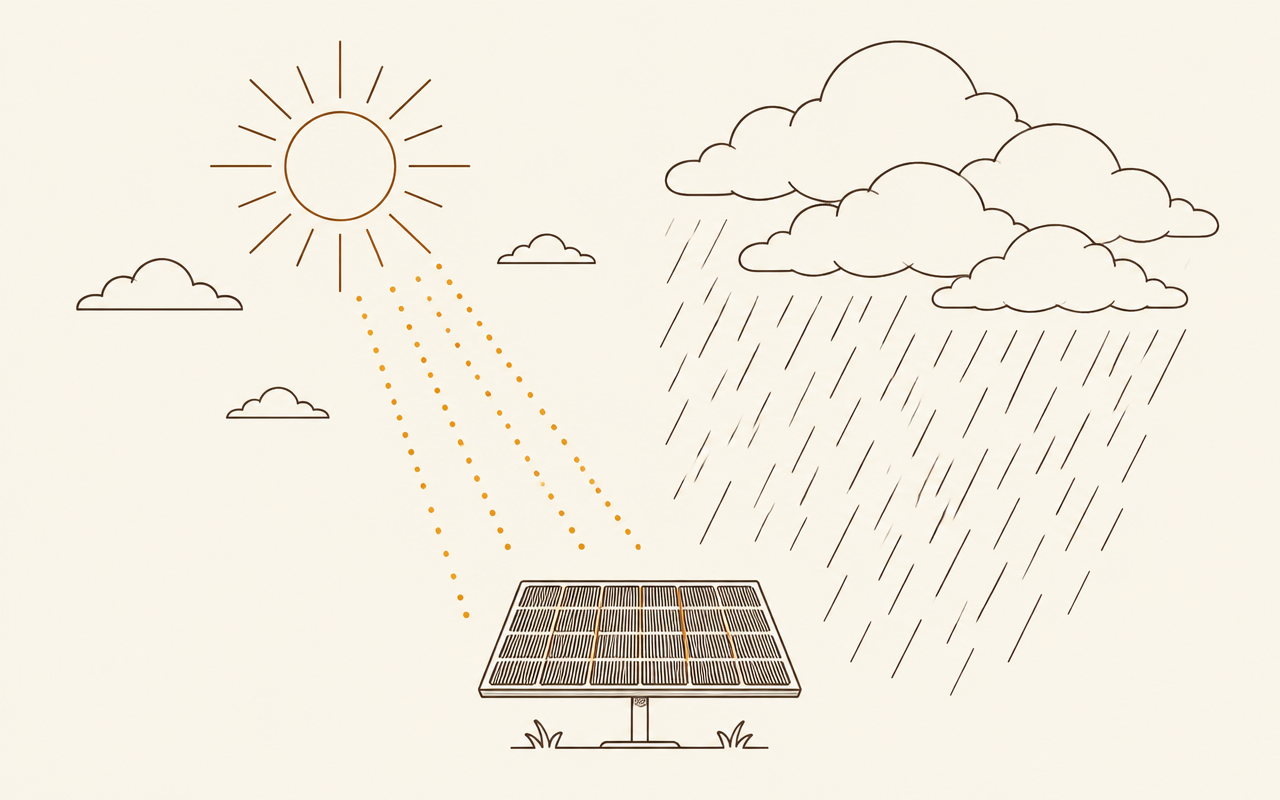
Solar irradiation in Indonesia changes throughout the year because the amount of sunlight reaching the ground depends on both the Sun's position and local weather. A 2026 study using PVWatts simulations examined solar potential in Indonesian cities, including Surabaya. It reported modeled daily solar irradiation of 7.18 kWh/m²/day in September and 3.91 kWh/m²/day in December, illustrating how strongly solar resources can vary between seasons.
Peak sun hours are a way to express this variation in a form useful for solar engineering. One peak sun hour represents the energy received when a surface gets 1 kW/m² of solar irradiance for one hour. Therefore, daily irradiation of 5 kWh/m² corresponds to approximately 5 peak sun hours. This is an energy-equivalence measure, not necessarily five hours of uninterrupted sunshine.
The main physical explanation for Indonesia's seasonal variation is its monsoon climate. During the drier months, clearer skies allow more solar radiation to reach the ground. During the wetter months, clouds reflect and scatter incoming sunlight, reducing the total energy available to solar panels. Earth's axial tilt also changes the Sun's apparent position over the year, but near-equatorial Indonesia, seasonal cloud cover can be especially important. NASA explains that solar energy reaching Earth's surface varies with both solar angle and atmospheric reflection.
In our view, the most useful implication is that a solar calculator should not assume that a location receives the same amount of sunlight every month. Using a single annual average is reasonable for preliminary estimates, but monthly irradiation data can produce more realistic predictions of seasonal electricity generation. The Surabaya figures also illustrate why a system sized using sunny-season conditions alone could overestimate its output during the rainy season. However, the reported values come from a simulation, and actual production will also depend on panel orientation, shading, temperature, and equipment losses.
- PVWatts-Based Assessment of Solar Photovoltaic Energy Potential in Indonesian Urban Areas for Infrastructure Planning Optimization (2026)
- NASA — Climate and Earth's Energy Budget